AI… yes I am here to talk about AI. Yet another post on this hot topic which might go missing in the abyss of the internet. Do I promise to sell you something new, something exciting, or something never seen before? Well no, I am not here to sell anything but rather to share some of my musings and learnings of this new technology and maybe introduce a new perspective.
Firstly, I would like too share what I feel is my definition of AI. From my perspective AI should stand for Augmented Intelligence. Mostly beacuse so far anything that has been developed has been done so by either extrapolation or intrapolation of ideas and knowledge. A good definition of intelligence which I sits right with me is:
“Intelligence is not what you know, but what do you do when you don’t know”
And in a way that’s how we have been measuring the success of intelligence as well. How well can they gneralize is implied for long tail scenarios and what action/plan does AI come up with when it is not seen it a-priori, i.e. out-of-distibution behavior. However, anything that AI generates hold value on when it is grounded in exisiting knoweldge or built aruond existing infrastucture. Outside that the ``halluciations” of AI do not add any meaning. And if you are in research you might have seen t already as to how easy it is to exhaust the ability of these systems. In the end AI seems to working well since it can fail much faster than a human.
What is balance and why that?
Being somebody who has been intrigued by control theory and control systems, the idea of balance and stability has been quite central to my thinking process. There has been a lot of debate about how learning based methods (AI) and control systems compare (mostly because a lot of AI is based on RL which is data-driven model free optimal control).
At the IROS 2026, I attended the workshop on BLPC 2026. There numerous talks and presenters, but the one talk I found especially intriguing was by Dr. Michael Posa (from my alma matter UPenn). While initially I forgot to pay attention to the title of his talk, eventually I myself came to the same conclusion (which I guess is the sign of a perfect talk/presentation). It focused on The AI Control Sandwich” (well it had a slightly different title). The idea is central to the belief that data-driven approaches and learning based approaches are hard to trust and deploy. They can show better behavior but fail to give any safety or stabiity gurantees. Model based & optimization based methods do provide such performance characteristics but they can struggle to adpat. Often controllers have to choose between being robust or adaptive.
What is the balance?
The balance here implies to how to effectively utilize the two while minimizing the dependence on either class of solutions to reduce the chances of failures caused by the solutions of that class.
- Too much data dependence: can we gather so much data? can we ensure stability/safety? what do we know about the performance gurantees?
- Too much control dependence: do I need to tune the costs? can it adapt to high level changes? how well does the control performance transfer on large distributional shift?
Why the balance?
The points made above pretty much naturally lead us to the conclusions that these two methods should be used in a combination. Leveraging one can help alleviate (maybe in a limited capacity) the limitations of the other. Or it can also be stated that together these systems can bolster each other resulting in a much stable system which can adapt as well a stay robust while also understanding context.
The final picture
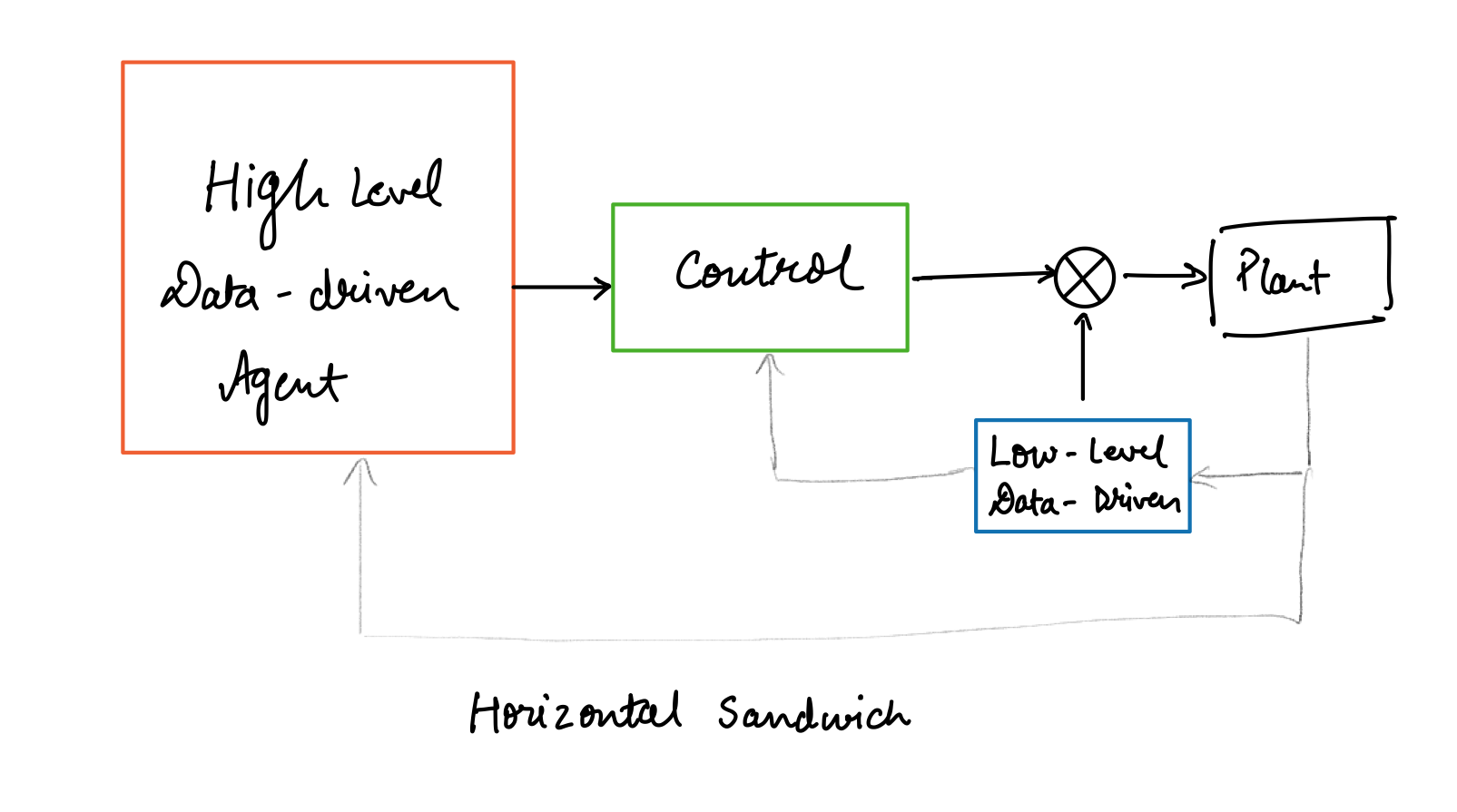
The major discussion that this workshop intended to stir, and that has been circling aorund, is “what is the appropriate way to combine the two?” And so far the sandwich seems to be the most promising way. Large data-driven methods seem to be very good at high-level context based switching and generating a class of behaviors. Overfit data-driven methods can be utilized for capturing heavily non-linear behavior, and have been very good at residual learning with structured canonical methods. Using control as the jelly, we can make a nice sandwich.
- High-level data-driven models understand context, update cost defintion, tune values, adpat felxibility of constraints
- Control is leveraged to execute this plan while preserving performance guarantees
- Low-level data-driven models can cover up with residual terms wherever the controller is lacking and adpat to performance setting
Concluding thoughts
Is this the final answer? I don’t think so. There are still so many things which are unanswered about how learning based methods work and what can we say about their performance parameters. Controls still has a long way to go as systems become more complex. No method is perfect and no method is useless. Data-driven methods are for sure here to stay and have already become pertinent but that does not mean that good ol’fashion engineering won’t be needed anymore. Just like the introduction of Excel changed how businesses operate, augmented initelligence will update how systems are engineered. And
As Prof. Morari once said to me during one of after-class discussion,
“We do not know the problem. We just try our best to model the problem and then find a solution to it. And then we define some parameters to obeserve the performance. The cost function and the constraints are just our intepretations of the problem.”
Hopefully, you might find this insightful.
-Siddharth
All thoughts and materials shared and mentioned on these blogs are mine and mine only.